Frequently Asked Questions
-
No.
The goal of the Save the '220 Project is historic preservation, not restoration to flying condition.
Returning a one-of-one prototype to flight would require extensive redesign, modern certification, and replacement of countless components.
While we did evaluate this possibility, the amount of time, funding, and margins of safety were determined to be unrealistic.
-
To recover, preserve, and place the world's only McDonnell Model 220 prototype in a permanent museum collection, while preserving its history, documentation, and stories.
-
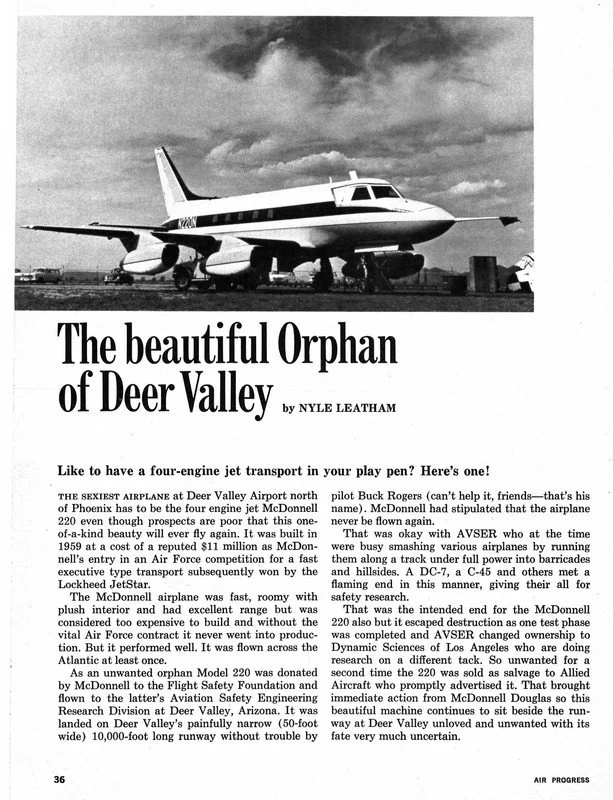
The McDonnell 220 lost the UCX contest in the 1950’s for a new Air Force light utility and VIP transport aircraft. It was later marketed to the civilian market, and in the process, became the very first business jet certified anywhere in the world.
Unfortunately, no firm orders ever came, which is why only the prototype was built. That being said, this aircraft represents the genesis of every business jet today. From the Learjet 23 to the Bombardier Global 8000, it all began with the McDonnell 220. -
The City of El Paso, Texas
-
We are presently in discussions with a number of major museums located throughout the United States. A major announcement will be made as soon as a deal is signed and accepted by all parties involved.
-
Potentially, but we are not seeking volunteers at this time. We are awaiting a formal proposal from a leading aircraft recovery specialist that will tell us exactly what we need more help with in the next phase of the project. We are, however, collecting a contact list of potential volunteers to be ready when we enter that phase.
-
Presently, the project is funded entirely by Brad Donner and Anthony West. We are awaiting the finalized recovery proposal from a leading aircraft recovery specialist that will help us identify our specific fundraising needs and goals. At that time, an announcement will be made.
-
Long term exposure to the desert without proper preservation would be incredibly detrimental to the state of the aircraft, and eventually it would become structurally unsound. Also, the airplane currently occupies a space that is needed for commercial use.
Options for preserving the aircraft in-situ were originally explored, but ultimately decided against as it would severely limit available resources for long term preservation. -
We certainly thought it might not be, at first.
However, extensive evaluation by aircraft preservation experts has shown that the aircraft is structurally recoverable. The engineering documentation still exists, the airplane can be disassembled and transported, and many of its components are conventional aerospace hardware. The challenge is significant, but it is fundamentally one of planning, logistics, and coordination rather than impossibility.