Every Project Has a story
Sometimes, curiosity kills the cat. sometimes, curiosity saves the ‘220
The Save the '220 Project truly began in 2017.
Founder Anthony West was early in his aviation career, flying a freight-converted Embraer 120 into El Paso, Texas, to pick up a load of camping stoves destined for New England. As he taxied across the airport, something unusual caught his eye—an aircraft he couldn't identify.
Having been fascinated by aviation since childhood, he dug deeper and learned that it was the sole prototype of the McDonnell 220. Even then, he immediately recognized its historical significance. Like most people who knew the airplane existed, however, he quietly hoped that someone else would eventually save it.
Eight years later, he found himself halfway around the world in Chiba, Japan, serving as a First Officer on the Boeing 747. It happened to be his birthday, and after the flight, his captain took the crew out for a night on the town. As often happens among pilots, the conversation drifted toward unusual aircraft they had encountered over the years, particularly the Aero Spacelines Super Guppy.
As the discussion turned toward some of aviation's more obscure airplanes, Anthony remarked,
"You know what else is really obscure and sitting in El Paso with the Super Guppy? The McDonnell 220."
None of his crewmates had ever heard of it, so he told them everything he remembered.
Later that evening, sitting alone in his hotel room, he searched for the airplane simply out of curiosity. It wasn't anything unusual—just reminiscing about his freight flying days in the desert.
Then something caught his attention. Only days earlier, the aircraft had been re-registered to the City of El Paso. A registration change on an airplane that had not flown since the 1990s was unusual, but once again, he closed his laptop and simply hoped that someone was finally going to preserve it. A few weeks later, acting on little more than a hunch, he emailed the El Paso airport authority to ask whether there were any preservation plans.
The answer was simple.
No.
Even worse, he was informed that if a preservation effort did not materialize, the aircraft would likely be scrapped. The airport authority then asked a simple question. "Do you know anyone who might be interested?"
His first answer was honest.
"No..." Then he paused. “…But I do know a lot of people. Let me see if I can find someone who may be interested."
That sentence marked the beginning of what would become the Save the '220 Project.
The First Problem
That very day, Anthony began searching for museum contacts, preservation specialists, aviation historians, and anyone else who might be able to help. Every phone call led to another recommendation. Every email produced another name.
Many organizations politely declined. Their concerns were legitimate. The aircraft was large. Transportation would be extraordinarily expensive. Nobody knew exactly how it had been assembled, whether it could safely be disassembled, or whether recovering it was even practical.
For many people, those concerns would have ended the conversation. Instead, Anthony treated every "no" as a list of engineering problems waiting to be solved.
After responding to each organization, thanking them for their time and acknowledging their concerns, one museum executive replied with a sentence that changed everything.
"Actually... if someone could solve those problems, we could be convinced."
In that moment, the Save the '220 Project was born.
The mission was no longer to find someone willing to save the airplane. The mission was to eliminate every obstacle preventing someone from saying yes.
The first obstacle was transportation. Nobody knew exactly how the aircraft had been assembled. Without that knowledge, nobody could determine whether it could be transported by highway. Before anything else could happen, one fundamental question had to be answered.
How do the wings come off?
Chasing Answers
That single question became the project's first engineering challenge. Anthony had never attempted to move a 30,000-pound prototype aircraft before. Just determining where to begin was difficult. Having spent years working on cars before becoming an airline pilot, his first instinct was simple: find the maintenance manual. There wasn't one. There are no maintenance manuals for a one-of-one prototype.
The next question became obvious.
What can be used instead of a maintenance manual?
A blueprint. But where does someone find blueprints for a prototype designed nearly seventy years ago? He began searching everywhere he could think of.
Soon another realization emerged.
Did he actually need a blueprint?
Factory assembly photographs soon surfaced showing the aircraft with its wings removed. That single discovery proved something critically important. The airplane could be disassembled. If a blueprint couldn't be found, perhaps something else could answer the question. Maybe a former mechanic had saved notes in a garage. Maybe a museum archive contained forgotten technical documents. Maybe someone who had worked on the program was still alive.
For the next seventy-two furious hours, the search became relentless.
Anthony assembled what is likely the largest private collection of McDonnell 220 technical documentation ever gathered. Every photograph, newspaper article, engineering sketch, historical reference, and technical document had the potential to answer the question that everything depended upon. Nothing was left unreviewed - but no blueprints surfaced.
He searched library archives, contacted museums across the country, and tracked down anyone who had worked on—or even adjacent to—the McDonnell 220 program.
Then came one of the project's first major breakthroughs.
He made contact with Brad Donner, the last pilot ever to fly the McDonnell 220. Brad confirmed something critically important. The aircraft had been assembled using conventional aircraft construction techniques and could, in principle, be disassembled using conventional methods. What they still lacked, however, was proof.
Proof would be required before any museum could seriously consider committing to such a complex recovery. With no definitive technical documentation emerging, it became clear there was only one option left.
Go to El Paso.
If the answers couldn't be found in archives, perhaps they could be found on the airplane itself. Plans were made.
As Anthony informed his growing network of contacts about the trip, another breakthrough occurred. One of the nation's leading aviation museums agreed to send its aircraft recovery specialist to evaluate the airplane alongside what had quietly become known as the Save the '220 Project.
For the first time, this was no longer one airline pilot chasing an idea. Experienced aircraft preservation professionals believed the McDonnell 220 was worth evaluating.
The Breakthrough
The team's objectives in El Paso were straightforward.
Determine whether the aircraft could realistically be transported. Document the airplane. Take measurements. If they were fortunate, perhaps they would uncover a few engineering drawings or maintenance records that would answer some of the remaining questions.
No one expected what happened next.
As word of the project spread through the small community of people connected to the McDonnell 220, another remarkable lead emerged. A former McDonnell mechanic had quietly preserved boxes of documents for decades. The team arranged to meet before visiting the aircraft. They expected maintenance paperwork. Perhaps a few photographs. Maybe a handful of engineering drawings. Any one of those discoveries would have made the trip worthwhile.
Instead, they found something no one believed still existed. As the team sorted through the collection, Brad Donner reached into the stack and pulled out a blue binder.
Across the front were four simple words.
Model 220 Prototype Design Book
The room fell silent. Inside were the original McDonnell engineering drawings. Assembly diagrams. Structural drawings. Systems documentation.
Original factory engineering information that had survived for nearly seventy years.
The search that had begun with one simple question—
"How do the wings come off?"
—had suddenly become something much larger.
The team wasn't looking at scattered engineering drawings. They were looking at the original design documentation for the prototype itself. It was, in every practical sense, the Rosetta Stone of the McDonnell 220.
Questions that had seemed impossible only days earlier now had a path toward an answer. The project's greatest unknown had become one of its greatest strengths.
Standing Before History
Armed with decades of engineering information, the team drove to the aircraft. For the first time, Anthony wasn't looking at the airplane simply as an aviation enthusiast, he was looking at it as someone trying to preserve it.
Every panel mattered. Every rivet mattered. Every structural joint became another clue.
Brad Donner walked around the aircraft he had last flown decades earlier, sharing stories that only someone who had operated the airplane could tell.
The museum's aircraft recovery specialist viewed the airplane through a different lens. He wasn't asking whether it was historically significant. That question had already been answered. He was asking whether it could be saved.
Measurements were taken. Thousands of photographs were captured. Every accessible portion of the aircraft was documented.
As the day continued, uncertainty slowly gave way to optimism.
The engineering challenges were real - but they were solvable.
Before leaving El Paso, one of the nation's most experienced aircraft preservation specialists looked at the airplane one last time and offered an assessment that would become a defining moment for the project.
"I do not see anything about this airplane that makes me say it can't be done."
For months, the question had been whether the McDonnell 220 could be saved.
That day, the question changed.
How are they going to do it?
Today, the Save the '220 Project is no longer simply about preserving an airplane. It is about preserving the people who designed it, built it, maintained it, flew it, and believed in it.
Every new contact, every newly discovered document, every photograph, and every volunteer has become another piece of a story that almost disappeared.
The Save the 220 Project didn't begin with an organization. It began with one person asking a question and refusing to let it go. If this story proves anything, it's that important history isn't always saved by institutions. Sometimes it's saved by ordinary people who decide that History Is Worth The Effort.
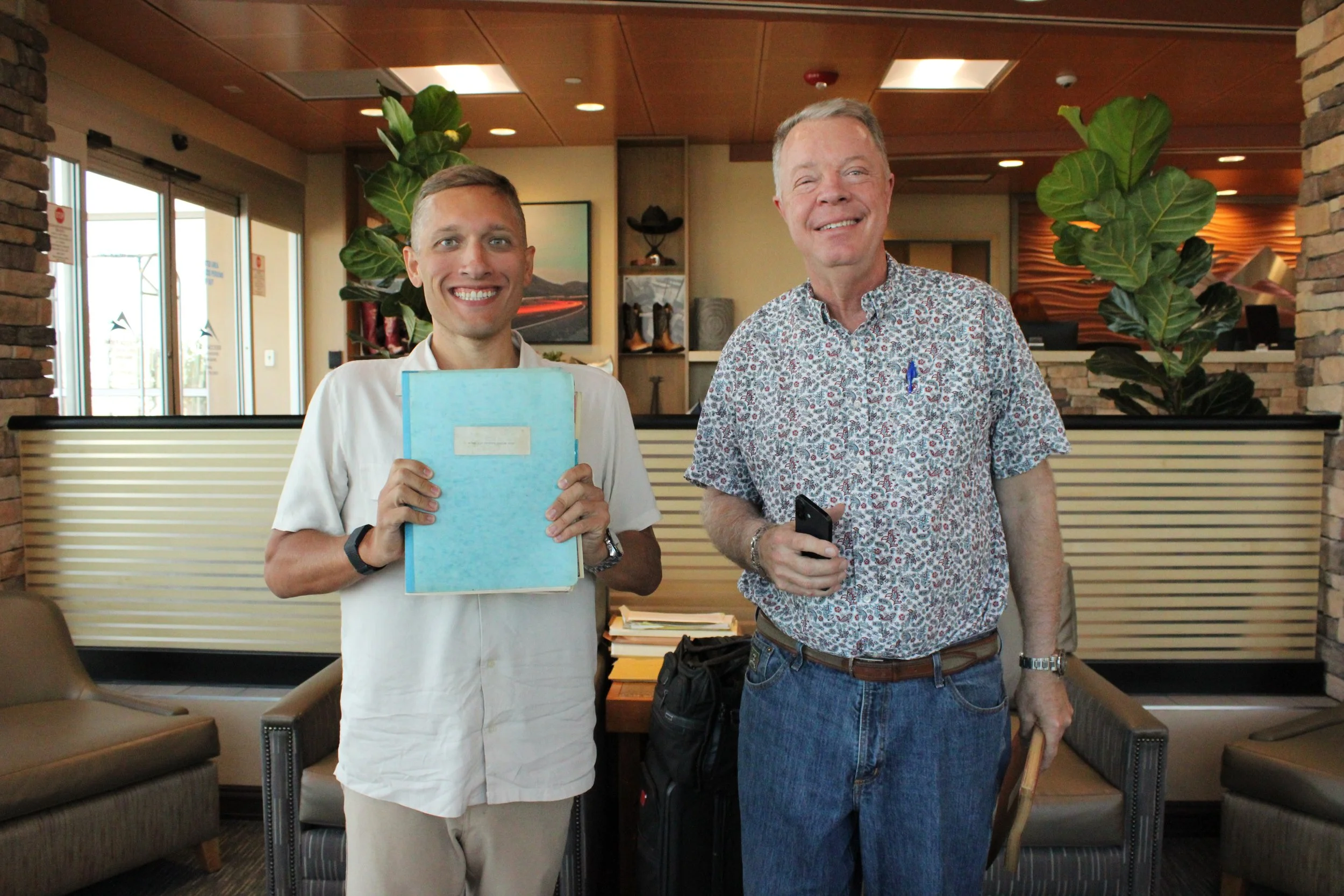
The moment everything changed: Brad and Anthony standing in the airport lobby, holding the Rosetta Stone for the Save The ‘220 Project